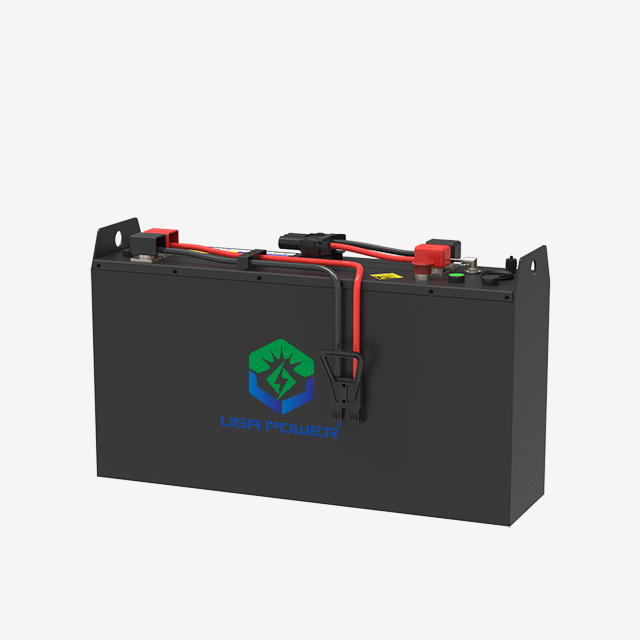
Industrial batteries are stored-energy sources designed or selected for industrial equipment, commercial vehicles and infrastructure power systems. The term covers more than one chemistry, size or construction. A battery may drive a forklift, support a telecom installation or store energy for later use, and each job sets different requirements. Understanding what industrial batteries are therefore means understanding their intended duty and system role. Lithium traction batteries, including forklift and golf cart products, provide familiar examples, but they sit alongside stationary backup and storage batteries within the wider category.
What Does “Industrial Battery” Mean?
In practical equipment discussions, the term identifies a battery intended to meet a defined operating requirement in a machine or power installation. It does not describe a single standardized electrical specification. The battery must supply the required load under specified conditions and work with the surrounding charging, protection and control equipment.
There is no universal capacity threshold that makes a battery industrial. A small battery supporting an industrial control device and a large forklift pack can both serve industrial roles. Their size differs because their tasks differ, not because one necessarily belongs outside the category.
The term is also used in regulatory contexts, where formal definitions can depend on jurisdiction and purpose. This article uses the practical equipment meaning; a product’s legal classification should be checked separately when required. A general blog definition should not be substituted for a market-specific compliance decision.
The Three Main Roles: Traction, Backup, and Storage
Traction batteries supply mobile equipment. They repeatedly deliver energy to a drive system and associated working functions. A lithium forklift battery supports travel and lifting; a lithium golf cart battery supports passenger or site transport. Their shared role is mobile power, although the vehicle loads and installation requirements differ.
Backup batteries support equipment when its normal power source is interrupted. A UPS or telecom system may keep its batteries ready for an event rather than using them for a full working cycle every day. Readiness, discharge capability for the intended support time and reliable recharge are central to that role.
Energy-storage batteries hold electricity for a later operating period. They work with converters, inverters or other power equipment according to the installation’s control strategy. Their use can overlap with backup, but a planned cycling schedule creates different operating assumptions from a system that rarely discharges.
These roles explain why the phrase industrial batteries is broad. They also explain why application is a better starting point than a chemistry label. Two batteries can share a chemistry while being designed for different roles.
What Is Inside an Industrial Battery System?
At its simplest, a battery contains electrochemical cells connected to provide the required electrical output. A complete industrial installation can also include an enclosure or tray, terminals, cables, protection devices, monitoring and a charging system. Which components are included in the supplied battery depends on the product and order scope.
A lithium pack commonly includes a BMS that monitors conditions such as cell voltage, current and temperature and responds to configured limits. The charger supplies the appropriate charging profile, while the equipment controller manages the machine’s operation. These components work together but do not perform the same job.
A cell, a module and a complete pack are different products. A module may need further engineering and connections before it forms an installed equipment battery. FOBERRIA’s LiFePO4 traction battery module is a useful example of why the supplied configuration should be identified precisely rather than inferred from the broad term industrial battery.
For lead-acid systems, construction affects maintenance. Flooded batteries contain liquid electrolyte and require the specified service routine; valve-regulated AGM and gel constructions have different requirements. The overall system still needs correct charging and installation regardless of construction.
What Features Matter in Industrial Service?
The important features follow the duty. Energy capacity influences how long a load can be supported; current capability influences whether the battery can supply a demanding event. A vehicle requires both. A reserve installation may prioritize the ability to support a specified load for a defined interval after an outage.
Temperature, vibration, water or dust exposure, available space and service access can affect the design and installation. These conditions do not make every industrial battery rugged in the same way. Environmental suitability must be established from the specific product instructions rather than assumed from the word industrial.
Maintainability also differs. Some systems require electrolyte servicing, while others rely more heavily on electronic status information and periodic connection checks. Reduced routine maintenance does not mean that the installed battery can be ignored. Inspection and operating practices remain part of its service conditions.
For a lithium traction battery, the pack’s current limits and charging behavior must fit the machine. For a stationary installation, the supported charger or power converter is equally important. Industrial use describes the context; documented specifications establish what the product can do in that context.
How to Read the Basic Battery Ratings
Nominal voltage describes the battery’s electrical class, not the exact voltage at every state of charge. The maximum charging voltage and lower operating limit are separate values. A familiar label such as 36V therefore does not describe every voltage the connected equipment will experience.
Ampere-hours describe charge capacity under stated conditions. Multiplying nominal voltage by Ah provides nominal energy in watt-hours. That helps compare stored energy, but it does not guarantee runtime because the actual load, temperature, usable reserve and operating limits affect the result.
Continuous discharge current and short-duration peak current describe different aspects of power delivery. A peak rating needs its duration to be useful. Cycle-life figures also need test conditions and a capacity-retention endpoint. Neither a peak-current headline nor a cycle count is a complete performance promise.
FOBERRIA’s 38.4V 105Ah cart battery provides a concrete example: its rated voltage and Ah describe a particular LiFePO4 configuration associated with a 36V-class cart application. Those ratings help identify the product; they do not establish compatibility with every cart in that class.
Term
What it describes
What it does not establish alone
Voltage
Electrical potential / system class
Full equipment compatibility
Ah
Charge capacity at stated conditions
Guaranteed hours or miles
Wh or kWh
Nominal stored energy
Usable energy in every condition
Discharge current
Permitted load capability
Operating duration without capacity data
Cycle life
Tested cycling performance
Guaranteed calendar years
How Are Industrial Batteries Different from Other Batteries?
The difference lies in the intended task and product design, rather than a universal dividing line based on size. A vehicle starting battery mainly delivers a brief starting event. A traction battery repeatedly supplies working energy. A reserve battery is selected for its support duty. Those differences affect the appropriate construction, ratings and operating routine.
Consumer and industrial products can use related cell chemistries, but the complete installation may differ in connections, controls, enclosure and service requirements. A shared cell chemistry does not establish that the finished batteries can be exchanged.
Similarly, a lithium forklift battery is not simply a larger version of a lithium golf cart battery. They are related examples within traction service, with equipment-specific loads and mechanical requirements. This distinction keeps the definition useful without turning it into an assumption of interchangeability.
When identifying an existing battery, read the label, determine the application and distinguish the chemistry from the duty. FOBERRIA’s replacement battery identification guide uses original equipment and battery information to establish the relevant product family before evaluating a replacement.
Conclusion
Industrial batteries are defined in practical use by the equipment or power task they serve. They include traction, backup and storage products across several chemistries and constructions. Understanding the application, the complete system and the meaning of basic ratings is more useful than treating industrial batteries as one product type. FOBERRIA manufactures lead-acid and lithium ranges, including vehicle products; each model still needs to be understood through its specific duty and documented operating conditions.
FAQ
Are industrial batteries always large?
No. Size follows the energy and power requirement; industrial instruments can use small batteries while vehicles need much larger packs.
Are all industrial batteries lithium?
No. Lead-acid and other chemistries also serve industrial applications.
What makes a battery a traction battery?
Its intended role is supplying mobile equipment with propulsion or working energy through a defined operating cycle.
Does more Ah mean more power?
Not necessarily. Ah describes charge capacity; allowable current and voltage also determine the load the battery can support.
Welcome To Contact Us
If you have any questions or needs about our products or services, please feel free to contact us at any time. We look forward to working with you and providing you with the best packaging solutions.